
Interpretation of the 2024 China AIDS Diagnosis & Treatment Guidelines
2024 China AIDS Diagnosis & Treatment Guidelines
On May 9, 2024, the AIDS Professional Group of the Infectious Diseases Branch of the Chinese Medical Association, in collaboration with the Department of Infectious Diseases at Peking Union Medical College Hospital and Professor Li Tai of the National Center for AIDS/STD Control and Prevention, officially released the China AIDS Diagnosis and Treatment Guidelines (2024 Edition)[1]. This edition of the Guidelines has been revised and expanded upon the 2021 edition of the Guidelines for the Diagnosis and Treatment of HIV/AIDS, taking into account the latest research developments both domestically and internationally.
Key Updates in the 2024 Guidelines
The predominant HIV-1 subtypes circulating in China are CRF07_BC, CRF01_AE, CRF08_BC, and subtype B[2]. The 2024 Guidelines integrate epidemiological and etiological data from 14 national laboratories, with key updates on HIV testing strategies, antiretroviral therapy (ART), management of HIV comorbidities, and HIV infection prevention. Notably, the guidelines introduce the concept of key populations for HIV/AIDS for the first time, and provide corresponding treatment recommendations with evidence levels and recommendation strengths. Major revisions and additions to HIV/AIDS testing, treatment, and related areas include:
According to the AIDS Prevention and Control Regulations, China implements a voluntary counseling and voluntary testing system for HIV/AIDS. To better identify undiagnosed cases, the updated guidelines recommend that healthcare workers proactively offer HIV-related testing and appropriate counseling to high-risk populations.
For spouses or sexual partners of HIV/AIDS patients, individuals with a history of injection drug use sharing needles with HIV/AIDS patients, patients with HIV/AIDS-related clinical symptoms or signs, and other populations at high risk of HIV infection, healthcare workers should proactively offer HIV-related testing and appropriate counseling.
In the "Clinical Laboratory Testing" section, the updated guidelines add HIV antigen testing, clearly stating that HIV antigen-antibody combination assays can simultaneously screen for HIV-1/2 antibodies and antigens, and may also be used for early diagnosis of HIV infection[3].
Clinical laboratory testing for HIV/AIDS primarily includes HIV antibody testing, HIV antigen-antibody testing, HIV nucleic acid testing, CD4+ T lymphocyte count, and HIV drug resistance testing. Screening tests typically use HIV antibody tests or HIV antigen-antibody combination assays to determine the possibility of HIV infection, supplemented by confirmatory testing (HIV-1/2 antibody differentiation assay) and nucleic acid supplemental testing (HIV-1 nucleic acid qualitative and quantitative testing).
HIV antibody and HIV antigen-antibody testing: HIV antibody tests simultaneously detect HIV-1/2 antibodies. HIV antigen-antibody combination assays simultaneously detect HIV-1/2 antibodies and p24 antigen. Commonly used methods for HIV antigen-antibody combination testing include ELISA, chemiluminescence immunoassay, fluorescent immunoassay, and rapid testing. Confirmatory testing typically uses HIV antibody differentiation assays, immunoblotting, recombinant immunoblot assay (RIBA), and other methods.
1. Screening test: A negative screening test result indicates no HIV-1/2 antibody or antigen reactivity, suggesting the individual is not infected with HIV. However, during the window period of infection, the screening test may also yield a negative result.
The updated Guidelines emphasise that early initiation of ART is recommended for all HIV-infected individuals, regardless of CD4+ T-lymphocyte count, in order to reduce morbidity and mortality; for patients for whom conditions permit, rapid initiation of ART (within 7 days of diagnosis) or initiation on the day of diagnosis is recommended [4]. In the section of the updated Guidelines regarding the frequency of CD4 testing, CD4 classification
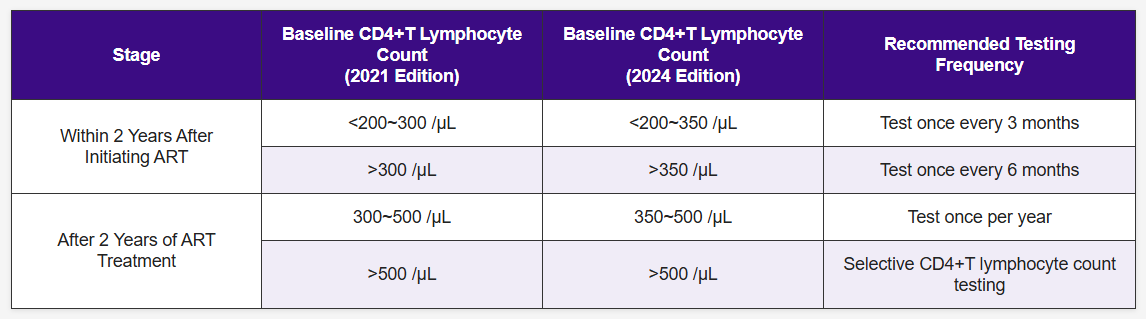
The frequency of CD4+ T lymphocyte count monitoring should be determined based on the patient's specific clinical condition. Before initiating ART, one baseline test should be performed; after starting ART, a follow-up test should be conducted at 3 months. Thereafter, monitoring should occur every 3-6 months for the first 2 years of treatment:
- For patients with CD4+ T lymphocyte count < 200-350 cells/uL, test every 3 months.
- For patients with CD4+ T lymphocyte count > 350 cells/uL, test every 6 months.
After 2 years of ART, for patients with sustained virological suppression on treatment:
- For patients with CD4+ T lymphocyte count between 350-500 cells/uL, CD4 monitoring may be reduced to once per year.
- For patients with CD4+ T lymphocyte count > 500 cells/uL, CD4+ T lymphocyte count monitoring may be selectively discontinued.
For patients with delayed ART initiation, ART failure requiring regimen change, or during treatment with recurrent viremia > 200 copies/mL, CD4 monitoring should be performed every 3-6 months. For patients with immunological breakthrough, those presenting with AIDS-defining clinical symptoms, or those unable to undergo regular CD4+ T lymphocyte monitoring, more frequent clinical monitoring is recommended.
For confirmatory testing, the updated guidelines recommend reagent-based methods as the preferred option. For nucleic acid supplemental testing, the guidelines lower the threshold for confirmatory and follow-up testing from the previous 5,000 copies/mL to 1,000 copies/mL, narrowing the confirmatory range and providing more precise criteria for clinical decision-making.
1. Nucleic acid supplemental testing: HIV-1 nucleic acid qualitative and quantitative testing is performed in nucleic acid supplemental testing laboratories. It is recommended to prioritize the use of reagent-based methods as the nucleic acid supplemental test. The HIV-1 nucleic acid qualitative test detects RNA or DNA and can confirm HIV-1 infection or rule out HIV-1 infection. The HIV-1 nucleic acid quantitative test has a detection limit of > 1,000 copies/mL; for results below 1,000 copies/mL, retesting should be performed. Clinicians may integrate epidemiological history, clinical manifestations, CD4+ and CD8+ T lymphocyte counts, and HIV antibody supplemental testing results to comprehensively analyze and rule out false positives. HIV nucleic acid testing is of important value for the diagnosis of patients in the acute window period / early infection period.
The updated guidelines revise the viral load monitoring schedule from the original 4-week and 12-week intervals to 4-8 weeks and 8-12 weeks[5]. The guidelines also introduce the concepts of "transient viremia (blips)" and "low-level viremia (LLV)" along with their clinical management strategies, emphasizing that all HIV-infected individuals should receive comprehensive, full-course management.
Additionally, the guidelines define key populations for HIV-infected individuals for the first time, primarily including: patients aged > 50 years, pediatric patients, pregnant women and breastfeeding women, patients with multiple underlying conditions, patients requiring highly emetogenic therapy, and patients with poor ART adherence or those lost to follow-up. The guidelines recommend individualized ART regimens and comprehensive management for these populations, with attention to multidisciplinary collaboration.
2. Regular viral load monitoring for treatment efficacy assessment[11] : HIV-1 nucleic acid quantification reflects the level of viral replication in the blood of infected individuals and is the key indicator for evaluating ART efficacy. It also serves as the primary indicator for adjusting ART regimens. One baseline test should be performed before ART; if conditions do not permit, testing should be done before starting ART, with regular monitoring thereafter. After initiating treatment, the first follow-up test should be performed approximately 4-8 weeks after treatment initiation, then every 8-12 weeks until the viral load reaches the detection limit. For patients who have achieved stable viral suppression, during the first 2 years of treatment, monitoring should occur every 3-4 months; after 2 years, monitoring may be reduced to every 6 months.
For patients with ART failure requiring a regimen change, one viral load test should be performed, followed by retesting at 4-8 weeks after the new regimen, then every 8-12 weeks until the detection limit is reached. For patients requiring ART change due to drug toxicity or intolerance, viral load testing should be performed at 4-8 weeks after the regimen change to confirm viral suppression. During treatment, for patients with viral load > 200 copies/mL, monitoring should occur every 3 months. For patients with new AIDS-defining clinical symptoms or those using corticosteroids or immunosuppressive drugs, viral load testing should be performed every 3 months.
Transient viremia (blips) and low-level viremia (LLV): After virological suppression, a single detectable HIV RNA measurement is referred to as a transient viremia (blip). Generally, a single blip does not indicate virological failure and is not associated with subsequent virological failure. Transient viremia typically does not require adjustment of the treatment regimen, but follow-up monitoring should be conducted at the virology laboratory.
If HIV RNA is detectable on two consecutive occasions at levels between 50-200 copies/mL, this is defined as LLV. LLV is associated with patient adherence, drug resistance, and drug-drug interactions. LLV generally does not require changing the treatment regimen, but HIV RNA should be monitored every 3 months to determine whether ART regimen adjustment is needed.
Given the increasing availability of integrase inhibitor drug classes, the growing use of long-acting formulations, and the potential for major transmission of drug-resistant strains prior to exposure, the updated guidelines add a specific recommendation for integrase resistance testing in the drug resistance testing section[6]. Baseline testing is recommended for patients at risk of drug resistance:
HIV screening testing results are typically confirmed through a combination of screening tests, confirmatory testing (HIV-1/2 antibody differentiation assay), and nucleic acid supplemental testing (HIV-1 nucleic acid qualitative and quantitative testing) to confirm HIV infection.
All HIV-infected individuals should undergo baseline drug resistance testing before initiating ART. For patients who acquire HIV infection while using CAB-LA for PrEP, or if there is suspicion of HIV infection with INSTI-class drug resistance, integrase resistance mutation testing should be performed.
Pre-NAT II HIV Viral Load Nucleic Acid Testing Solution
The HIV-1 Nucleic Acid Quantitative Assay (PCR-Fluorescence Method) and Pre-NAT Fully Automated Nucleic Acid Extraction System are designed for blood screening applications, providing timely and reliable screening solutions for clinical laboratories and blood stations, while also offering an integrated reagent solution for the blood screening industry.
Human Immunodeficiency Virus (HIV-1) Nucleic Acid Detection Kit (Fluorescence PCR Method) - Focused on the Pre-NAT II high-throughput fully automated detection platform and the overall solution for high-sensitivity HIV detection reagents, contributing to the fight against HIV/AIDS at CDCs and medical institutions at all levels.
Simultaneously detects HBV, HCV, and HIV-1 nucleic acids in a single reaction, improving testing efficiency while reducing costs and turnaround time.
Ultra-low limit of detection ensures reliable identification of low-level viremia, critical for early diagnosis and blood safety screening.
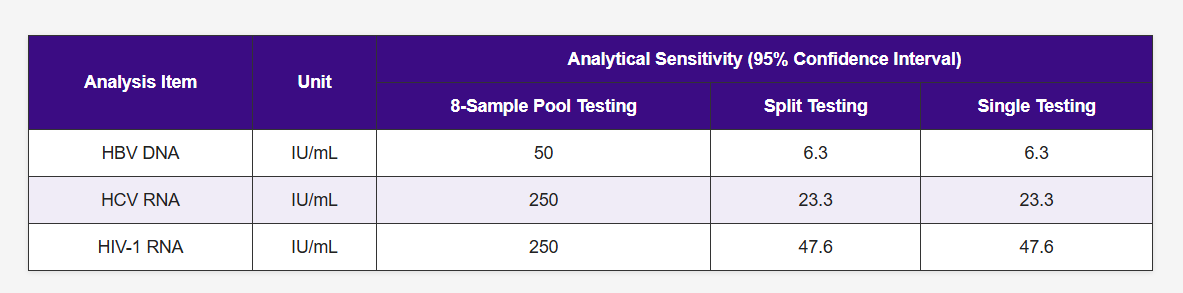
The Pre-NAT II fully automated nucleic acid extraction system automates the entire workflow from original sample processing, nucleic acid extraction, to PCR reaction setup, reducing manual intervention and improving detection sensitivity.
DNA and RNA dual internal control systems monitor nucleic acid extraction and PCR amplification efficiency, preventing false-negative results.
Magnetic bead transfer technology combined with the UNG-dUTP system provides dual prevention of PCR product contamination.
References
- AIDS and Hepatitis C Professional Group, Branch of Infectious Diseases, Chinese Medical Association; Chinese Center for Disease Control and Prevention. Guidelines for the Diagnosis and Treatment of HIV/AIDS in China (2024 Edition) [J]. Chinese Journal of Infectious Diseases, 2024, 42. DOI: 10.3760/cma.j.cn311365-20240328-00081.
- Zhong P. Advances in Research and Practice of HIV Molecular Epidemiology [J]. Electronic Journal of Emerging Infectious Diseases, 2019, 4(3): 137-144. DOI: 10.3877/j.issn.2096-2738.2019.03.003.
- Chinese Center for Disease Control and Prevention. National Technical Specifications for HIV Testing (2020 Revised Edition) [EB/OL]. (2020-05-18) [2024-03-09]. http://ncaids.chinacdc.cn/zxzx/zxdteff/202005/W020200522484711502629.
- Jing FH, Lv W, Li TS. A New Perspective on Immune Reconstitution in HIV-Infected Patients: CD4/CD8 Ratio [J]. Chinese Journal of AIDS and Sexually Transmitted Diseases, 2018, 24(6): 643-646. DOI: 10.13419/j.cnki.aids.2018.06.32.
- Panel on Antiretroviral Guidelines for Adults and Adolescents. Guidelines for the use of antiretroviral agents in adults and adolescents living with HIV. Department of Health and Human Services[EB/OL]. [2024-02-18]. https://clinicalinfo.hiv.gov/en/guidelines/hiv-clinical-guidelines-adult-and-adolescent-arv/whats-new.
- Gandhi RT, Bedimo R, Hoy JF, et al. Antiretroviral drugs for treatment and prevention of HIV infection in adults: 2022 Recommendations of the International Antiviral Society-USA Panel[J]. JAMA, 2023, 329(1): 63-84. DOI: 10.1001/jama.2022.22246.
